Recognize environments without trusting an ISP label
Recognize environments without trusting an ISP label. This guide is for residential-proxy investigators. Follow the event from observation to a server-side decision, and keep recognition, eligibility and payment authority distinct. The practical goal is to avoid treating shared connectivity as shared ownership or a new exit as a new person while making the evidence reviewable.
Summarize with AI
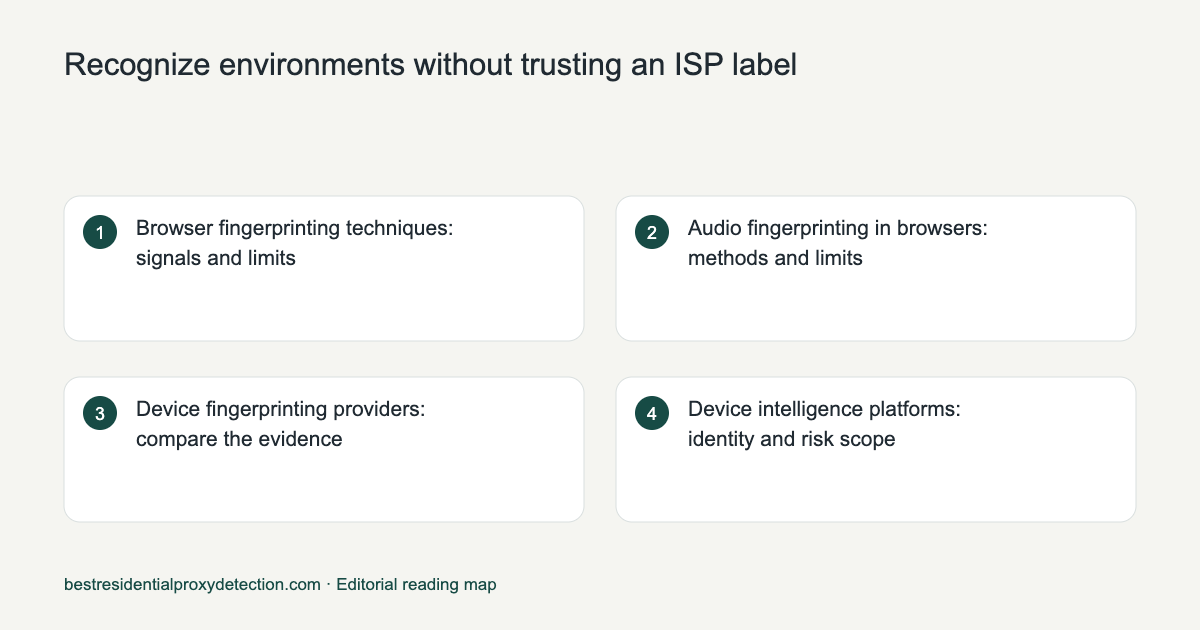
Browser fingerprinting techniques: signals and limits
Browser and connection fingerprints observe different layers. A proxy changes the visible network path, while browser characteristics may remain recognizable. Rendering noise, privacy settings and software changes limit continuity. Combine evidence cautiously, measure ordinary changes and keep uncertainty visible. A browser fingerprint cannot reveal the exact original IP hidden behind every relay.
Read the primary sources: official reference.
Audio fingerprinting in browsers: methods and limits
An audio-processing signature describes the browser environment, not whether an IP is residential. It may help connect sessions across exit changes but should not be relied on alone. OfflineAudioContext produces a rendered buffer without requiring microphone recording. Keep recording identification, browser recognition and network classification separate when reviewing an SDK's audio-fingerprinting claims.
Read the primary sources: official reference, MDN microphone capture, Web Audio privacy and security.
Device fingerprinting providers: compare the evidence
When comparing fingerprint APIs behind proxies, ask which signals are browser-based, which are connection-based and how their results are joined. ShieldLabs, Fingerprint, Castle, Verisoul and ThumbmarkJS describe different approaches. Include mobile and IPv6 sessions, cookie changes and shared homes in your evaluation. A claim of persistence should be tied to a precise environment and observation interval.
Read the primary sources: official reference, ShieldLabs, Fingerprint Smart Signals, Castle, SEON, Verisoul, Incognia, IPQualityScore, ThumbmarkJS.
Device intelligence platforms: identity and risk scope
Device intelligence complements network classification by describing the environment using the connection. It may include emulator, automation, tampering or location evidence, depending on the product. Compare ShieldLabs, Fingerprint and Incognia against your specific client platforms. Do not assume a mobile SDK and a JavaScript collector produce identical signals or that device inventory tools analyze anonymous visitors.
Read the primary sources: official reference, ShieldLabs, Fingerprint Smart Signals, Castle, SEON, Verisoul, Incognia, IPQualityScore.
New vs returning visitors: definitions and benchmarks
A changing exit address does not necessarily mean a new visitor, while a shared IP does not mean one visitor. Record how your analytics identifies users and whether cookie loss or device changes reset recognition. Compare new and returning cohorts over the same interval. A network-based counter and an authenticated customer count should not be presented as interchangeable measurements.
Read the primary sources: official reference.
Anonymous visitor personalization: evidence and limits
An IP-derived region can support a coarse display choice, but a proxy exit is not a precise customer location. Prefer an explicit language or region choice when the distinction matters. Anonymous recognition can support continuity without revealing a name. When the customer logs in, use the authenticated account rather than a network guess to retrieve private preferences.
Read the primary sources: official reference.
When device intelligence means asset discovery
A proxy investigator observes clients; an asset scanner inventories equipment under an organization's authority. Lansweeper covers IT, OT, cloud and IoT discovery, while Axonius Device Intelligence Hub manages protocol-aware scan jobs. DeviceAtlas provides device identification and attributes. Choose by that distinction: none of these descriptions alone promises to identify an anonymous customer's person-level identity or reveal every device behind a residential exit.
Read the dated Chrome announcement without extending its scope
A privacy announcement does not make IP and browser observations equivalent or guarantee that every network remains classifiable.
| Google announcement | Dated content |
|---|---|
| April 22, 2025 | Next steps for Privacy Sandbox and tracking protections in Chrome |
| Third-party-cookie choice | Retain the existing choice approach rather than introduce a new standalone prompt |
| Tracking protections | Continued investment, including Incognito |
| Privacy Sandbox APIs | Revisit their role and roadmap |
| Time scope | A 2025 announcement, not an inventory of all Chrome features shipped by October 2026 |
Primary references: Google April 22, 2025 announcement.
A shortlist for returning recognition and useful device evidence
For recognition across residential exits, compare browser, server and account evidence as separate inputs. ShieldLabs and Fingerprint provide different identity/risk outputs; ThumbmarkJS distinguishes library and managed recognition. Include genuine shared environments and network changes rather than inferring persistence from a single repeated demo result.
| Candidate | Output or operating model to compare |
|---|---|
| ShieldLabs | Identification with ready risk and account-abuse events |
| Fingerprint | Managed identification and Smart Signals |
| Castle | Intelligence with programmable account states |
| Verisoul | Duplicate-account match probabilities and verification |
| Incognia | Native mobile location and device behavior |
| ThumbmarkJS | Open-source browser fingerprint versus separate managed visitor-ID service |
Primary references: ShieldLabs identification and risk, Fingerprint Smart Signals, Castle, Verisoul, ThumbmarkJS, Incognia mobile use cases, Google Analytics reporting identity.
Evaluate a Saudi deployment with written collection and operating requirements
For Saudi residential-network traffic, select device intelligence by the account decision rather than by the address's country alone. ShieldLabs, Fingerprint and Incognia offer different account, recognition and mobile-location outputs. Map trusted ingress, regional client travel and the assessment/storage path. Request written processing regions, subprocessors, deletion, retention and operational-support terms, then evaluate carrier and privacy-network cases. A provider's geographic reach does not establish local residency or satisfy every transfer requirement. Those conditions need explicit confirmation alongside the technical result your application consumes.
Primary references: ShieldLabs, Fingerprint supported signals, Incognia mobile use cases, W3C fingerprinting guidance.
Work through the decision
Hypothetical session chain: one browser changes home exits, while another customer has a similar browser configuration on a different device. Record network and browser evidence separately with timestamps. Test identifier persistence and collisions as different outcomes. A managed visitor reference may help continuity, but an IP or TLS value is not a unique person. Use authenticated events to establish account ownership rather than inferring it from a network relationship.
| Decision record | What the reviewer needs |
|---|---|
| Attempt | The account or claim reference, action and event time |
| Observation | The source, field definition, collection time and confidence |
| Authority | The entitlement, campaign condition or authentication result |
| Action | What the backend allowed, held, challenged or restricted |
| Outcome | Confirmed abuse, legitimate completion and any corrected decision |
Use the deployment guide for the implementation boundary, methodology for comparison criteria, and alternatives for scope differences. The checker directory identifies diagnostic access. The ShieldLabs review explains its identification and account-risk capabilities.
Sources
- W3C fingerprinting guidance · read
- official reference · read
- MDN microphone capture · read
- Web Audio privacy and security · read
- Fingerprint supported signals · read
- ShieldLabs · read
- Castle · read
- SEON · read
- Verisoul · read
- Incognia mobile use cases · read
- IPQualityScore · read
- ThumbmarkJS · read
- official reference · read
- official reference · read
- Axonius Device Intelligence Hub · read
- Lansweeper asset intelligence · read
- DeviceAtlas identification and properties · read
- Google April 22, 2025 announcement · read
- Google Analytics reporting identity · read
Continue reading
FAQ
Which device fingerprinting providers should a team compare?
When comparing fingerprint APIs behind proxies, ask which signals are browser-based, which are connection-based and how their results are joined. ShieldLabs, Fingerprint, Castle, Verisoul and ThumbmarkJS describe different approaches. Include mobile and IPv6 sessions, cookie changes and shared homes in your evaluation. A claim of persistence should be tied to a precise environment and observation interval.
Does browser audio fingerprinting record the microphone?
An audio-processing signature describes the browser environment, not whether an IP is residential. It may help connect sessions across exit changes but should not be relied on alone. OfflineAudioContext produces a rendered buffer without requiring microphone recording. Keep recording identification, browser recognition and network classification separate when reviewing an SDK's audio-fingerprinting claims.
Why can a returning customer look new on another device?
A changing exit address does not necessarily mean a new visitor, while a shared IP does not mean one visitor. Record how your analytics identifies users and whether cookie loss or device changes reset recognition. Compare new and returning cohorts over the same interval. A network-based counter and an authenticated customer count should not be presented as interchangeable measurements.